
Embodied Carbon - An Introduction
Updated Jul 24, 2025
What is Embodied Carbon?
Embodied carbon refers to the greenhouse gas emissions associated with building materials and products (raw material supply, transport, manufacturing, etc.). Embodied carbon in the building sector is estimated to be responsible for over 20% of global greenhouse gas emissions.
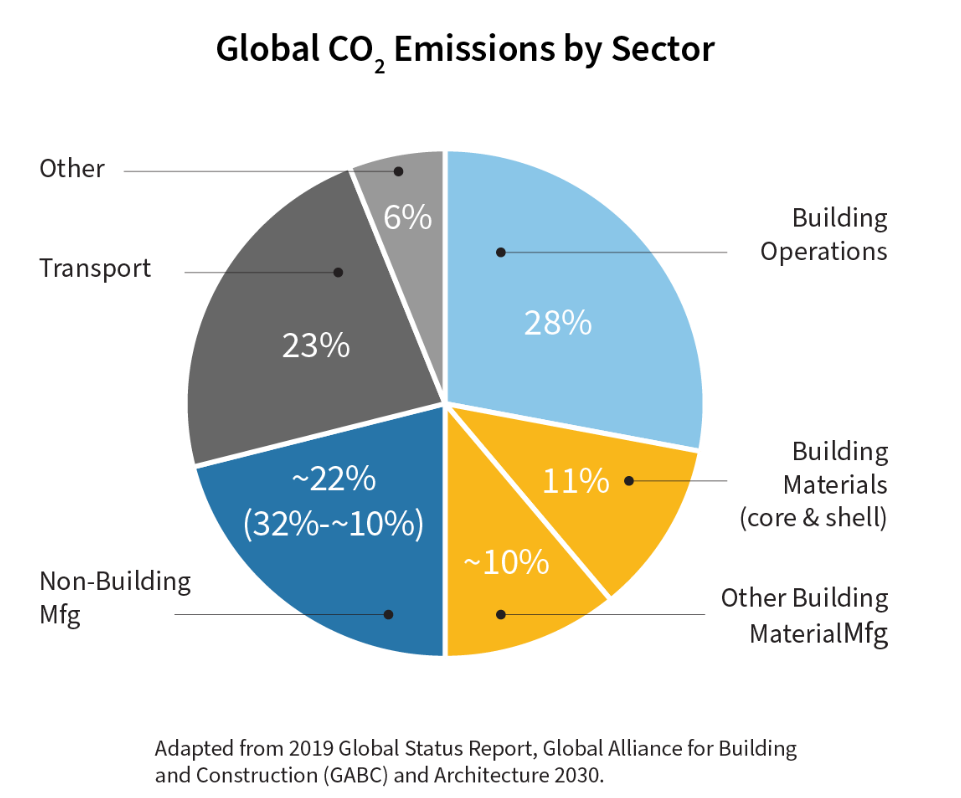
Image source: Carbon Leadership Forum (CLF)
Reading:
- Carbon Leadership Forum (CLF)
- ULI Knowledge Finder: The Developer's Guide to Embodied Carbon
- Institute for Market Transformation (IMT)
- Rocky Mountain Institute (RMI)
- BuildingGreen
- Canadian Architect
- Greentech Media
- Pacific Institute for Climate Solutions
Videos:
- Carbon Leadership Forum (CLF) Embodied Carbon Video Training Series
- HDR Carbon Balance (11 min)
- Endeavour Centre (6 min)
- Bill Gates (1 min)
Policy Maps:
As buildings get more and more energy-efficient, embodied carbon becomes a larger and larger share of the emissions that the building sector is responsible for,
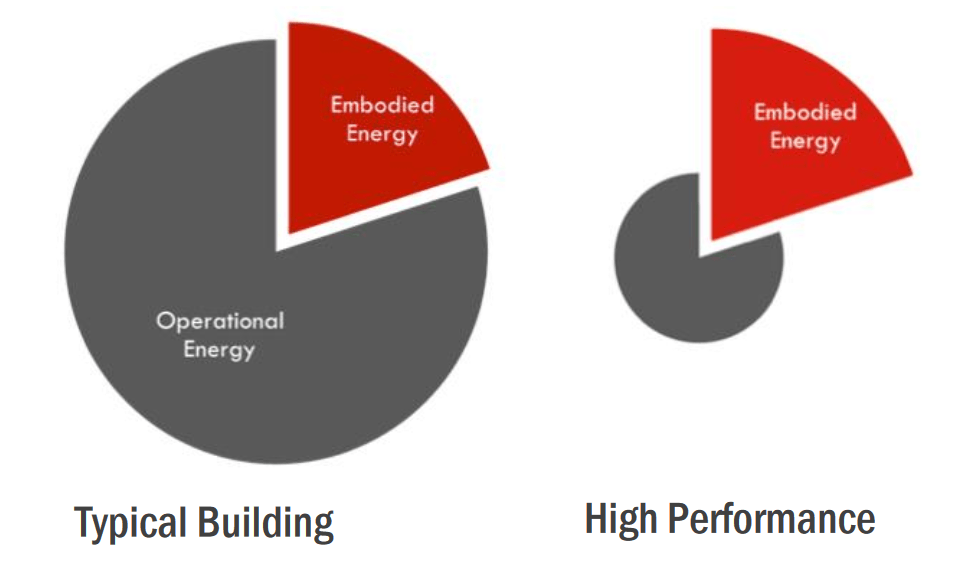
Image source: Institute for Market Transformation (IMT)
How Does Reuse Reduce Embodied Carbon?
We can drastically cut down on embodied carbon emissions by reusing building materials, because reusing materials reduces the need for some of the most emissions-intensive portions of the life cycle of materials (raw material supply, transport, manufacturing).
According to the consulting company Atelier 10, "Starting with the remaining carbon budget, factoring in the rate at which buildings are currently spending carbon, and the expected rate of construction over the coming decades, we can extrapolate that buildings need to hit a carbon intensity value of just under 200 kgCO2e/m2 each for us to stay under the 1.5 degree mark (and ideally, much below that). Few projects built today are even close to 200 kgCO2e/m2. Hitting this target requires rethinking industry norms, incorporating cutting edge low-carbon products, and committing to building reuse."
The City of Portland was the first city in the US to adopt a deconstruction ordinance. In 2019, a study conducted to estimate the carbon reductions attributed to the ordinance concluded that, "City of Portland data shows that since the ordinance, about 100 single-family homes per year are being deconstructed instead of demolished. With a net carbon reduction per home of 7.6 metric tons of CO2eq over demolition, this equates to a roughly 760 metric tons per year of CO2eq benefit. According to the EPA greenhouse gas equivalencies calculator, this is the same as removing 161 cars from the road for one year, or preventing the use of about 85,000 gallons of gasoline."
Link to more info:
- National Trust for Historic Preservation: The Greenest Building
- Setting an Embodied Carbon North Star (2023)
- Carbon Leadership Forum (CLF, 2024)
- Carbon Leadership Forum (CLF, 2025)
Additional resources:
- US Green Building Council (USGBC) and Rocky Mountain Institute (RMI)
- LMN Architects
- Pacific Institute for Climate Solutions, Making Embodied Carbon Mainstream
- Circular Economy Indicators Coalition (CEIC) Corporate Circular Target-Setting Guidance 2023
- Circle Economy - The Circularity Gap Report 2023
- UN Resource Efficiency and Climate Change 2020
- Ellen MacArthur Foundation - Completing the Picture - How the Circular Economy Tackles Climate Change 2021 Reprint
- Global ABC Report - Building Materials and the Climate: Constructing a New Future
- Heritage BC - Climate Adaptation: Conservation and Building Reuse are Climate Action
- Ecological Building Network - The Total Carbon Study - Case Study of the DPR Construction San Francisco Office Building - Net Positive Existing Building Reuse 2015